
Men’s Intimate Wellness
Does masturbation cause weakness? What the evidence supports
Many men quietly connect ordinary tiredness, low mood or sexual worry with masturbation. The concern deserves a respectful answer, not ridicule and not a product that promises to “restore” lost strength.
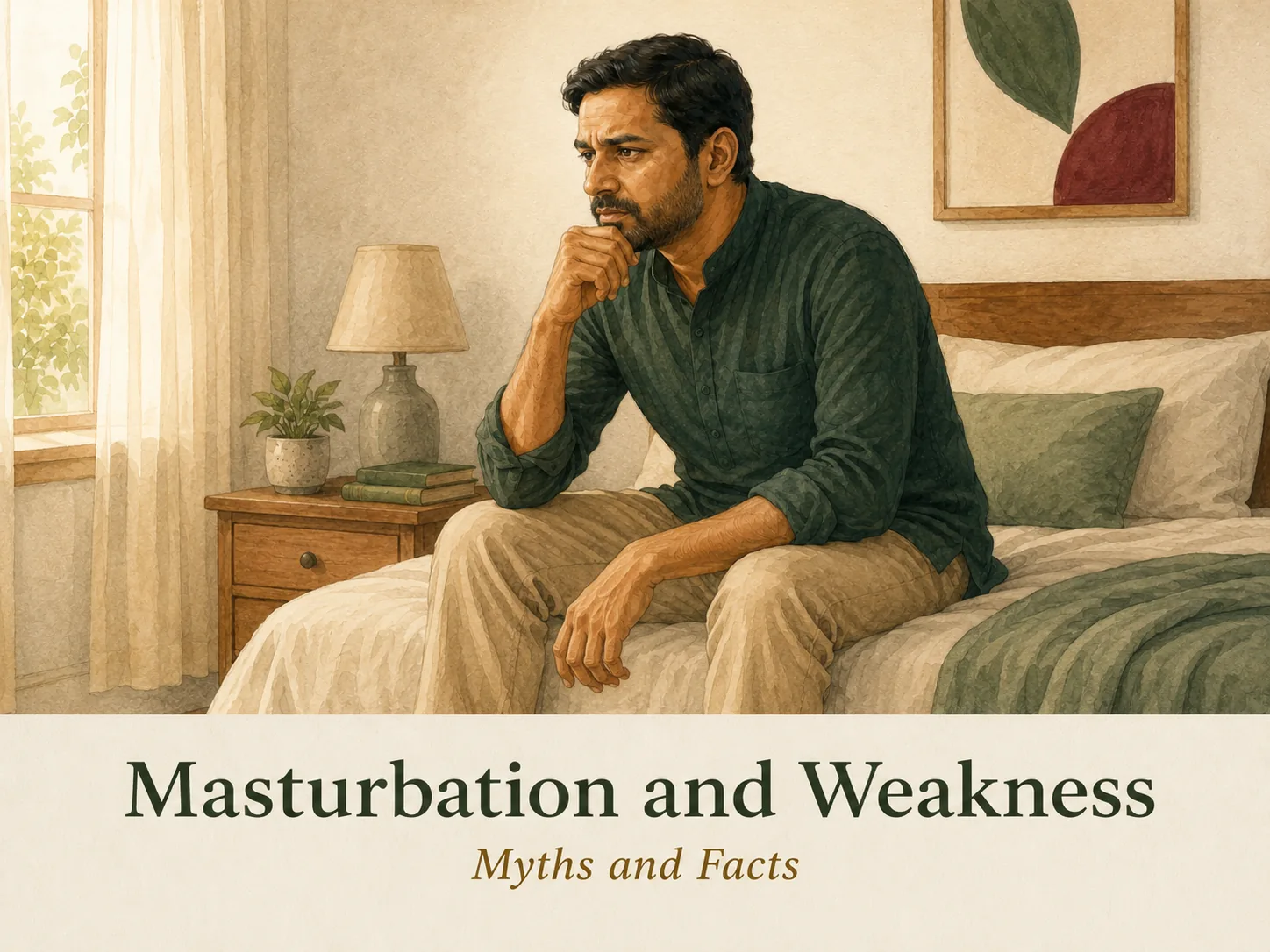
Why the fear is common
Beliefs linking semen with permanent strength are repeated through family advice, advertising and online forums. Once the fear starts, ordinary sensations can feel like proof: a tired day, low appetite or anxiety becomes “evidence” that the body has been damaged.
The distress is real even when the feared explanation is inaccurate. A good consultation separates the event, the belief and the symptoms instead of dismissing all three together.
What the evidence supports
Public-health guidance does not treat masturbation itself as a cause of permanent physical weakness. Research in men has found masturbation frequency to have weak or no association with erectile functioning when other factors are considered.
This does not mean every habit is harmless in every context. Friction can cause temporary soreness or injury. Sleep loss, compulsive use, distress and repeated online sexual-content use may create separate problems. Those concerns should be discussed directly rather than explained as “semen loss.”
A common belief
“Each ejaculation removes a fixed amount of strength that the body cannot replace.”
What is more accurate
The body does not operate as a fixed lifetime store that is permanently emptied by ordinary ejaculation. Fertility and semen quality are assessed separately when needed; they cannot be judged from tiredness, appearance, frequency or fear.
When weakness needs its own review
Persistent fatigue can have many explanations, including poor sleep, stress, mood, nutrition, infection, medicines and other health conditions. It should not automatically be blamed on masturbation — and it should not automatically be dismissed as anxiety either.
Arrange medical assessment when weakness is persistent, worsening, accompanied by weight change, fever, breathlessness, chest symptoms, faintness, marked low mood or another significant change.
When the behaviour feels out of control
A clinical concern is not defined by a universal number. Assessment becomes useful when a person repeatedly cannot reduce the behaviour despite trying, when it takes over important parts of life, or when it causes marked distress or impairment.
Distress caused only by moral disapproval is not, by itself, enough to diagnose compulsive sexual behaviour disorder. The clinician still takes the distress seriously and explores control, consequences, mood, anxiety and the person’s values without shaming them.
Physical symptoms that need assessment
Seek medical advice for:
- pain, injury, swelling or bleeding
- blood in semen
- urinary burning, discharge or difficulty passing urine
- persistent erection or ejaculation changes
- severe anxiety, hopelessness or inability to function normally
These symptoms have their own possible causes. They should not be grouped together under “weakness.”
What a consultation can clarify
A private consultation is mainly a conversation: what you are worried about, what symptoms are actually present, how sleep and mood have been, whether the behaviour feels controlled, and what products or advice you have already tried.
If the main concern is erection difficulty, the erection-concerns page is a better starting point. If the main fear is that semen loss itself is draining strength, the Dhat concern page addresses that belief directly. Tests or referral may be suggested when the history points to another health issue.
Before you come in
Write down:
- the exact symptom you want explained
- when the worry started
- sleep, mood and energy changes
- pain, urinary symptoms or sexual-function changes
- medicines, supplements or “strength” products already used
Do not buy unverified restoration products. Do not set a “safe number” from social media. Do not stop prescribed medicines without the prescriber’s advice.
Questions people ask
Does masturbation cause weakness?
Evidence does not support permanent bodily weakness from masturbation itself. Persistent fatigue deserves its own assessment rather than a guess.
Can masturbation cause erectile dysfunction?
Research does not show a simple direct link based on frequency alone. Persistent erection difficulty should be assessed by pattern, health, medicines, stress and context.
How often is too often?
There is no universal number. Concern is based more on loss of control, injury, distress and disruption to daily life.
Does semen loss reduce fertility?
Fertility cannot be judged from ejaculation frequency or appearance. When fertility is the concern, appropriate history and testing are needed.
When should I speak to a doctor?
When there is pain, injury, bleeding, urinary symptoms, persistent sexual-function change, severe distress, or behaviour that feels difficult to control.
Sources
- NHS Scotland sexual-health guidance: medical evidence does not support common harm myths about masturbation
- Rowland DL et al. Do pornography use and masturbation play a role in erectile dysfunction and relationship satisfaction? International Journal of Impotence Research. 2023
- Kraus SW et al. Compulsive sexual behaviour disorder in the ICD-11. World Psychiatry. 2018
- Briken P et al. Assessment and treatment of compulsive sexual behavior disorder. 2024
A private next step
WhatsApp opens with an editable message. Nothing is sent until you press send.
Read next
This guide is educational. It does not diagnose, replace an examination or provide emergency care.
Prefer BharatClinic on Google
Add BharatClinic as a Preferred Source to find more of our health guides and updates in Google Search.