
Skin & hair · Guide 11
Baal jhadna kaise roke: karan aur kya sach mein kaam karta hai
Why hair falls more than usual, what genuinely helps, what doesn't, and which patterns need a doctor soon.

Dr. D.K. Sharma, BAMS7 min read
The short answer
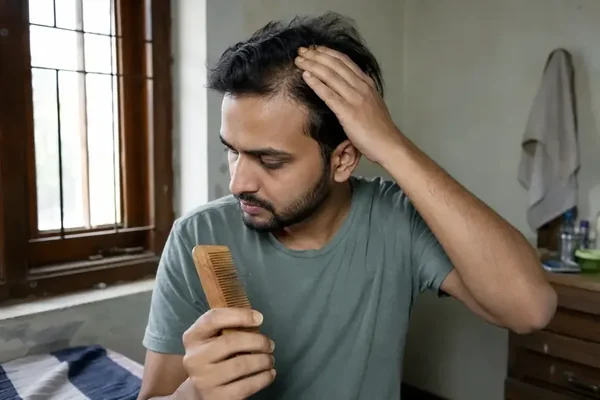
About 55 seconds to readSome hair falls every day; that is part of the hair cycle.1 When shedding clearly rises, or the parting widens, stopping it (baal jhadna kaise roke) starts with the cause, because different kinds of hair fall need different answers. Shedding after an illness, fever or childbirth often settles once the trigger has passed. Inherited thinning can often be slowed, but no one can honestly promise lost hair will come back.
See a doctor soon: if hair falls in round patches, the scalp is painful, red or has pus-filled sores, or there is scarring. The full list is under "When it can't wait".12
Key points
Key points from this guide
Each line is quoted word for word from the section it links to.
Contents 10 parts · 7 min
Karan: the main kinds of hair fall
The reasons for hair fall are often more than one at once: a recent trigger, an inherited pattern, thyroid, iron or diet, hormones, breakage, or patches on the scalp.12
- Shedding all over after a trigger: illness, high fever, surgery, childbirth, a crash diet or a stressful time.
- Inherited thinning: gradually, at the crown, temples or parting, in men and in women.
- Thyroid, iron and nutrition: an under- or overactive thyroid, low iron stores or a very restricted diet.
- Hormones: PCOS, stopping hormonal contraception, or around menopause.
- Hair breaking: tight hairstyles, heat, straightening and chemical treatments.
- Patches: round bald patches, or a scaly patch that can be a fungal infection.3
Kya sach mein kaam karta hai: what genuinely helps
To reduce or prevent hair fall, start by finding the trigger, then keep to gentle hair care and regular meals with enough protein. Inherited thinning is covered in the short answer above.
- Finding the trigger. If shedding began after an illness or childbirth, knowing that often means waiting while the cycle resets.
- Testing when useful: thyroid, haemoglobin and ferritin, and sometimes vitamin D or B12, with the reason explained.
- Regular meals with enough protein, rather than crash diets.
- Gentle care at home (gharelu upay): looser hairstyles, less heat and fewer chemical treatments, a wide-toothed comb on wet hair.2 This is everyday hair care, not a remedy for the cause, and no single home remedy fits every cause (see the next list).
- Patience. Hair grows slowly, so any change takes months to show.
What doesn't help much
- Switching oils and shampoos every few weeks, or trying one home remedy after another. No single oil or home remedy fits every cause. An oil may change how the scalp feels, but it can't correct inherited thinning, a thyroid problem or low iron.
- Supplements taken without a test. Extra vitamins don't help hair if you aren't short of them, and some can be harmful in excess.
- Anything sold with a promise that hair will grow back. Be careful with anyone who makes that promise.
Belief vs fact
Belief: "Hair fall means the body is weak, and oiling every night will stop it."
What is more accurate: hair fall has several causes, from a recent illness to an inherited pattern, and the right step depends on which it is.1 Oiling can be part of hair care, but it doesn't treat the cause.
When it can't wait
Urgent signs
Arrange a prompt medical review if:
- hair falls out in clear round patches, or eyebrows or eyelashes go too;
- the scalp is painful, red, scaly or has pus-filled sores;
- there is scarring or shiny skin where hair was;
- hair is coming out quickly all over;
- it comes with tiredness, weight change, feeling cold or irregular periods.12
A child with a scaly or sore patch should see a doctor soon. Go the same day if it is swollen with pus or comes with fever.3
When reading is not enough
If hair fall has gone on for weeks and you still do not know why, a consultation can narrow it down. Dr. D.K. Sharma (BAMS) asks when it started, what happened in the months before, your diet, sleep, periods and medicines, and what you use on your hair. He then looks at the scalp. Where Ayurvedic treatment fits alongside this is explained in hair fall and how Ayurvedic treatment fits. The consultation is ₹500, in person in Ludhiana or by video, and a personalised Dinacharya (daily-routine) guide follows. You can book a consultation or consult by video.
Related: dandruff and scalp itching · white hair at a young age · all skin and hair concerns
What to note before you go
- When the shedding started, and what happened two or three months before it.
- All over, or in one area; shedding or breaking.
- Any change in diet, weight, sleep or stress.
- For women: the cycle, acne or unwanted hair.
- Every oil, shampoo, dye and tablet you use (bring the bottles).
- Any thyroid, blood or vitamin reports.
Questions people ask
How much hair fall a day is normal?
Losing 50 to 100 hairs a day is normal. A change matters more than a number: shedding that has clearly increased for weeks, a wider parting, or scalp showing where it did not before.1
Will my hair grow back?
It depends on the cause. Shedding after an illness or childbirth often settles and the hair grows in again over months. Inherited thinning can often be slowed; regrowth can't be promised.
Does stress cause hair fall?
A very stressful time can trigger shedding a few months later.1 It usually settles once the stress has passed, though it is worth checking other causes too.
Can dandruff cause hair fall?
Dandruff on its own does not cause baldness. Heavy scratching, or a very inflamed, scaly scalp, can make hair break or shed more, and treating the scalp condition usually settles that part. If the scalp is red, sore or has patches, have it looked at; dandruff and scalp itching explains the causes.
Which blood tests help?
Thyroid, haemoglobin and ferritin, and sometimes vitamin D or B12, are the ones most often useful. A test is suggested only when it could change the plan.
Sources
- NHS. Hair loss. nhs.uk.
- American Academy of Dermatology. Hair loss: who gets and causes. aad.org.
- NHS. Ringworm. nhs.uk.
A source list shows what informed the guide. It is not a sentence-by-sentence review.
Written by Dr. D.K. Sharma, BAMS. Medical content approved by Dr. D.K. Sharma.
Reviewed by Dr. D.K. Sharma. Approval recorded on 8 November 2026 for this exact text.
About this guide
- Written by
- Dr. D.K. Sharma, BAMS
- Reviewed by
- Dr. D.K. Sharma (approval recorded on 8 November 2026 for this exact text)
- Reading time
- 7 minutes · 1239 words
- How we review
- BharatClinic editorial policy
The author link goes to /sexologist-in-ludhiana/, as on the live page. A neutral author profile URL would suit guides on piles and digestion better.
Questions or corrections: drdksharma@bharatclinic.com