
Sleep & stress · Guide 15
Ghabrahat kyon hoti hai: anxiety ke lakshan aur kab doctor se milein
Why ghabrahat happens, how anxiety shows in the body and mind, what helps, and when to see a doctor.

Dr. D.K. Sharma, BAMS9 min read
The short answer
About 65 seconds to readGhabrahat means anxiety or nervousness: the body's alarm system switching on, with a racing heart, tight breath and a mind full of worry.1 It is a normal response to pressure, but when it comes often, lasts for weeks, or stops you doing ordinary things, it may be an anxiety condition, and it is worth assessing.12 Ghabrahat usually comes from several things together: pressure that doesn't let up, poor sleep, a lot of tea or coffee, and sometimes a thyroid problem or a medicine.1 Regular activity, sleep, less caffeine and talking therapies all help.23
Urgent signs: thoughts of harming yourself need help now (call 112 or Tele-MANAS on 14416), and chest pain, fainting or breathlessness need emergency care first; the full list is under "When it can't wait".456
Key points
Key points from this guide
Each line is quoted word for word from the section it links to.
Contents 10 parts · 9 min
Ghabrahat ke lakshan: how anxiety shows
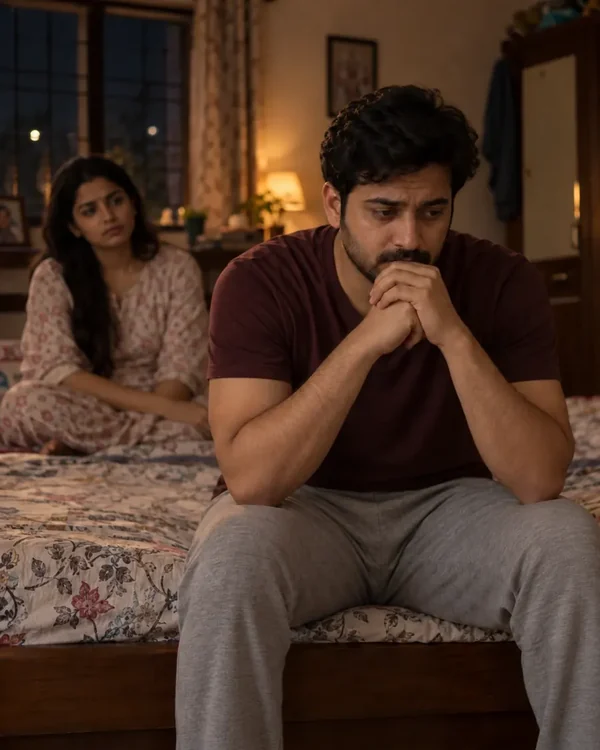
The signs show in both the body and the mind: a racing heart, a tight chest or an upset stomach, and worry that is hard to switch off.1
In the body1:
- A racing or pounding heart, sweating, trembling.
- Tight chest, shallow breath, a feeling of not getting enough air.
- Stomach upset, nausea, needing the toilet often.
- Tense muscles, headaches, poor sleep.
In the mind1:
- Constant worry that is hard to switch off.
- Feeling on edge, restless or irritable.
- Trouble concentrating, expecting the worst.
A panic attack is a sudden wave of intense fear with strong physical symptoms, often peaking within minutes.4
In Hindi, Punjabi and Hinglish
| You may say or search | It means |
|---|---|
| ghabrahat (घबराहट; Punjabi ਘਬਰਾਹਟ) | Anxiety or nervousness: a restless, uneasy feeling, often with a racing heart or a tight chest |
| ghabrahat hona | Feeling anxious or uneasy |
| anxiety ke lakshan, panic attack ke lakshan | The signs of anxiety are in the lists above; for a panic attack, see the sentence just above |
| ghabrahat ki tablet, ghabrahat ki dawa | A tablet or medicine for anxiety (see the medicine question under Questions people ask) |
| chittodvega | The classical Ayurvedic word for an agitated mind |
Common questions in Hinglish, each with a short answer and where the full one is:
- Ghabrahat ko English mein kya kehte hain? Anxiety or nervousness.1 Full answer: "What is ghabrahat in English?"
- Ghabrahat kya hota hai? The body's alarm system switching on.1 Full answer: "The short answer"
- Ghabrahat kyu hoti hai? Usually several things together.1 Full answer: "Ghabrahat kyon hoti hai: what keeps it going"
- Ghabrahat ho to kya kare? Breathe in slowly through your nose and out for longer through your mouth, and sit or stand still; it usually passes within minutes.4 With chest pain, fainting or breathlessness that doesn't settle, get emergency care. Full answer: "Ghabrahat ho to kya kare? What helps in the moment?"
- Ghabrahat ki tablet ya dawa hai? This page cannot choose a tablet for you. Anxiety can often be treated without medicine, and some people need one from a psychiatrist or physician.2 Never start or stop one on your own.7 Full answer: "Is there a ghabrahat ki tablet or dawa, or can anxiety be treated without medicine?"
Ghabrahat kyon hoti hai: what keeps it going
Ghabrahat hone ke karan (the causes) are usually several things together:1
- Pressure that doesn't let up: work, money, exams, caring for someone, conflict at home.
- The body's alarm: a racing heart is felt as danger, which brings more worry.
- Avoidance: staying away from what feels hard brings short relief and makes the next time harder.
- Sleep and stimulants: poor sleep, a lot of tea or coffee, nicotine and alcohol all raise tension.
- Health and medicines: an overactive thyroid and some medicines can feel like anxiety.
What helps: ghabrahat ka ilaj
- Slow breathing: breathe out longer than you breathe in, for a few minutes, when ghabrahat rises.
- Regular activity: a daily walk or other exercise.2
- Less caffeine and alcohol, especially later in the day.2
- A steady sleep routine.
- Talking: to someone you trust, and to a professional if it lasts. CBT is a recommended talking therapy.2
Belief vs fact
Belief: "Ghabrahat is just in the mind; be strong and it will pass." What is more accurate: anxiety is a real condition with physical symptoms, and it responds to the right support.3 Avoiding help often lets it grow.
When it can't wait
Urgent signs
If you have thoughts of harming yourself or ending your life, call 112 (India's emergency number) or go to the nearest emergency department now. You can also call Tele-MANAS, the Government of India's mental-health helpline, on 14416 (toll-free).56
Get emergency care now for chest pain, fainting or breathlessness with panic-like symptoms: the heart must be ruled out first, even if you have had panic attacks before.4 Arrange a prompt review if panic attacks keep happening, anxiety stops you working or leaving home, or low mood has lasted two weeks or more.2
When reading is not enough
If ghabrahat keeps returning, or is getting in the way of work, sleep or home life, talking it through with a doctor can help. Dr. D.K. Sharma (BAMS) listens first: what sets it off, how it feels, your sleep, caffeine, health and medicines. He tells you plainly when a psychologist, psychiatrist or physician should be involved. The consultation is ₹500, in person in Ludhiana or by video, and a personalised Dinacharya (daily-routine) guide follows. Book a consultation · Consult by video
Stress and anxiety · Insomnia and poor sleep · All stress and sleep concerns
A one-week note
- When the ghabrahat comes, and what was happening.
- How long it lasted, and what eased it.
- Cups of tea, coffee or energy drinks each day.
- Bedtime, wake-up time and how you slept.
- Every medicine and supplement you take.
Questions people ask
Is ghabrahat a heart problem?
Usually not, but chest pain, fainting or breathlessness must have the heart ruled out first, especially the first time.4 Once the heart is checked, anxiety can be addressed with confidence.
What is ghabrahat in English?
Ghabrahat usually means anxiety or nervousness: a restless, uneasy feeling, often with a racing heart, sweating or a tight chest.1 When it comes suddenly and strongly, doctors may call it a panic attack.4 The classical Ayurvedic word is chittodvega.
Ghabrahat ho to kya kare? What helps in the moment?
Breathe in slowly through your nose and out for longer through your mouth, sit or stand still, and remind yourself it will pass, as it usually does within minutes.4 If there is chest pain, fainting or breathlessness that doesn't settle, get emergency care.
Is there a ghabrahat ki tablet or dawa, or can anxiety be treated without medicine?
This page gives general information. It cannot choose a tablet for you.
What is known in general. Often, anxiety can be treated without medicine. Talking therapies such as CBT, regular activity and better sleep are well supported.2 Some people also need medicine from a psychiatrist or physician. Some prescribed medicines, including some sleeping tablets and antidepressants, can cause withdrawal effects if stopped suddenly, so never start or stop one on your own.7 Few well-designed trials show that Ayurvedic approaches work, and some Ayurvedic products have been found to contain lead, mercury or arsenic at toxic levels.8
At the clinic. After assessment, Dr. Sharma may advise routine and Ayurvedic treatment alongside, planned around any medicine you take. If you need a prescription medicine for anxiety, he refers you to a psychiatrist or physician.
Is anxiety curable, or will I always feel like this?
Anxiety usually improves gradually with the right support, with ups and downs. No page can promise a cure, and how it goes differs from person to person; how long it takes is decided after assessment.
Can ghabrahat stop me sleeping?
Often, yes. A racing mind at bedtime is one of the commonest reasons for poor sleep, and poor sleep makes anxiety worse the next day. The guide to neend na aana has night habits that help.
Can I start by video?
Yes. If you prefer, the first consultation can be by video; the video consultation page explains how it runs.
Sources
- NHS. Stress; Generalised anxiety disorder in adults. nhs.uk.
- NICE. Generalised anxiety disorder and panic disorder in adults: management (CG113). nice.org.uk.
- World Health Organization. Anxiety disorders (fact sheet). who.int.
- NHS. Panic disorder. nhs.uk.
- Ministry of Health and Family Welfare, Government of India. Tele-MANAS, 14416. telemanas.mohfw.gov.in.
- Government of India. Emergency Response Support System, 112. 112.gov.in.
- NICE. Medicines associated with dependence or withdrawal symptoms (NG215). nice.org.uk.
- NCCIH (US National Institutes of Health). Ayurvedic Medicine: In Depth. Last updated January 2019. nccih.nih.gov.
A source list shows what informed the guide. It is not a sentence-by-sentence review.
Written by Dr. D.K. Sharma, BAMS. Medical content approved by Dr. D.K. Sharma.
Reviewed by Dr. D.K. Sharma.
About this guide
- Written by
- Dr. D.K. Sharma, BAMS
- Reviewed by
- Dr. D.K. Sharma
- Reading time
- 9 minutes · 1634 words
- How we review
- BharatClinic editorial policy
The author link goes to /sexologist-in-ludhiana/, as on the live page. A neutral author profile URL would suit guides on piles and digestion better.
Questions or corrections: drdksharma@bharatclinic.com