







Gastritis, peptic (stomach) ulcer and H. pylori: symptoms, tests and treatment
Does this sound like you?
Gastritis means the stomach lining is inflamed; a peptic (stomach) ulcer is an open sore in that lining or the first part of the small intestine. The two most common causes of ulcers are H. pylori infection and regular anti-inflammatory painkillers, and both are found with tests, not guessed from the pain.12 Acid reflux can feel alike, so this page explains how the three differ, which warning signs need care at once, and which tests may be suggested.
Urgent signs: vomiting blood or something like coffee grounds, black sticky stools, or sudden severe stomach pain can mean a bleeding or burst ulcer and need emergency care now. The full list is under “When it should not wait”.1
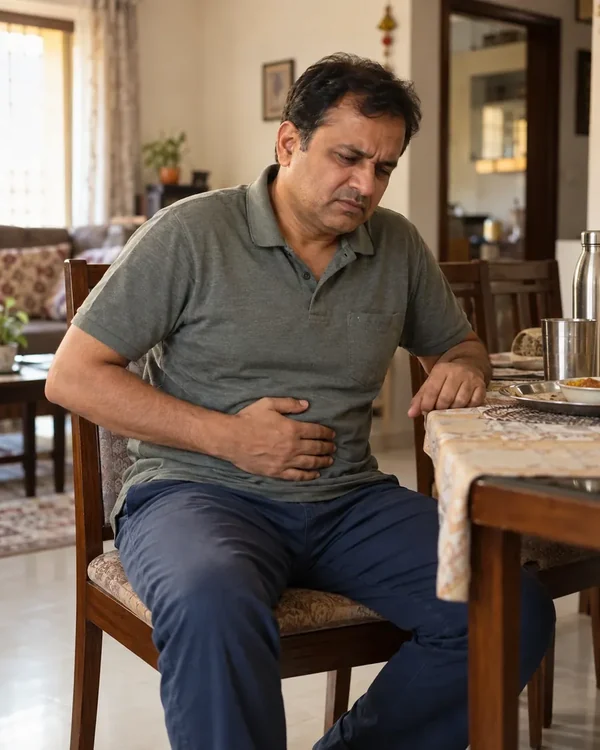
- A burning or gnawing pain in the upper stomach, between the ribs, that comes and goes.
- The pain is worse when the stomach is empty, or soon after eating.
- You feel full quickly, bloated or sick, or you burp a lot.
- You take painkillers such as ibuprofen, diclofenac or aspirin often.
- A test said "H. pylori positive", or a doctor mentioned gastritis or an ulcer.
Most upper stomach pain is not serious.1 If it keeps returning, or comes with any sign in the next section, see a doctor.
What it is, and what it isn't
Gastritis means the lining of the stomach is inflamed. A peptic ulcer is an open sore in the lining of the stomach (a gastric ulcer) or the first part of the small intestine (duodenum).12 Gastritis can lead to an ulcer, but many people with gastritis never get one. People sometimes call this "pet mein chhale" or "pet mein jalan".
The two most common causes of ulcers are an infection called H. pylori and regular use of anti-inflammatory painkillers (NSAIDs) or aspirin.1 Alcohol and smoking can make things worse.2
| Gastritis | Peptic ulcer | Acidity or reflux | |
|---|---|---|---|
| Where | Stomach lining, inflamed | A sore in the stomach or duodenum | Acid rising into the food pipe |
| Typical feeling | Burning, nausea, fullness | Gnawing pain, often with an empty stomach or at night | Burning behind the breastbone, sour taste |
| Can it bleed? | Sometimes | Yes, and it can be serious | Rarely |
For heartburn and sour burps, see acidity and reflux. If pain is your main symptom and you are unsure what it is, see stomach pain.
In Hindi, Punjabi and Hinglish
Show the words and Hinglish questionsHide the words
| You may say or search | It means |
|---|---|
| ulcer (अल्सर), peptic ulcer | An open sore in the lining of the stomach or the first part of the small intestine (duodenum).12 |
| pet mein chhale (पेट में छाले), pet mein jalan | Everyday words people use for gastritis or an ulcer. |
| gastritis | Inflammation of the lining of the stomach.12 |
| antral gastritis | Inflammation of the antrum, the lower part of the stomach.2 |
| H. pylori (एच. पाइलोरी) | A germ (bacteria) that can infect the stomach lining and cause gastritis and ulcers.12 |
| endoscopy | A test that looks inside the food pipe, stomach and top of the intestine with a thin tube and camera.5 |
Common questions in Hinglish:
- Ulcer kya hota hai? A peptic ulcer is an open sore in the lining of the stomach or the first part of the small intestine (duodenum).12 Full answer: “What it is, and what it isn't”
- Gastritis kya hota hai? Gastritis means the lining of the stomach is inflamed. Gastritis can lead to an ulcer, but not everyone with gastritis gets one.12 Full answer: “What it is, and what it isn't”
- Gastritis ke lakshan kya hain? A burning or gnawing pain in the upper stomach, between the ribs, that comes and goes, with fullness, bloating or nausea. Black stools or vomiting blood need emergency care.1 Full answer: “Does this sound like you?”
- Endoscopy kya hota hai, aur endoscopy kaise hoti hai? A thin flexible tube with a camera is passed through the mouth to check inside the food pipe and stomach. It should not be painful: the throat is numbed and sedation is sometimes given.5 Full answer: “What is an endoscopy, and is it painful?”
- H. pylori kya hota hai? H. pylori is an infection and one of the two most common causes of ulcers.1 It is usually tested with a breath test or a stool test.13 Full answer: “How is H. pylori tested?”
- Antral gastritis kya hota hai? The antrum is the lower part of the stomach. Antral gastritis means that part of the lining is inflamed, often because of H. pylori infection or painkillers.2 Full answer: “What is antral gastritis?”
When it should not wait
Urgent signs
Get emergency care now if:1
- you vomit blood or something that looks like coffee grounds
- your stools are black, sticky and tarry
- you have sudden, severe stomach pain that is getting worse
- you feel faint or breathless
These can be signs of a bleeding or burst ulcer.
Arrange a prompt medical review, which may mean an endoscopy, if:34
- you are losing weight without trying
- you have difficulty or pain swallowing
- you keep vomiting
- you have an upper stomach lump
- you are 55 or older with indigestion and weight loss
If you take a prescribed medicine for your stomach, blood thinning or the heart, don't stop it on your own. Ask the doctor who prescribed it.
How Dr. Sharma assesses it
- The pain. Where it is, what it feels like, when it comes (empty stomach, after food, at night), and what eases it.
- Warning signs. Black stools, vomiting, weight loss and swallowing problems are asked about first.
- Medicines. Every painkiller, aspirin, steroid or blood thinner, how often, and for how long; and any antacid or acid-reducing tablet you take.1
- Food and habits. Meal timing, tea, spicy and fried food, alcohol, smoking, stress and sleep.
- Tests, when useful. H. pylori is usually tested with a breath test, a stool test or, during an endoscopy, a small sample.13 For the result to be reliable, acid-reducing tablets usually need to be stopped for two weeks beforehand, but only on your doctor's advice.3 An endoscopy, a camera test done by a gastroenterologist, is advised when warning signs or age call for it.3
What treatment can and can't promise
- Gastric ulcer treatment: H. pylori needs its prescribed treatment. If the test is positive, the infection is treated with a course of antibiotics and an acid-reducing medicine, prescribed by a doctor.13 Finish the full course, and don't swap it for anything else.
- Painkillers. If an NSAID is the cause, your doctor may change it. Don't stop a medicine you need for your heart without asking.1
- Don't stop prescribed treatment. Ayurvedic care may be added alongside prescribed treatment, never as a replacement. No product is named here.
- Routine. Regular meals, less alcohol and smoking, and attention to stress and sleep, with your personalised Dinacharya (daily-routine) guide after the consultation.
- Honest outcomes. Most ulcers heal with the right treatment; they can return if the cause stays.1 A repeat test may be needed to check H. pylori has gone.
Your doctor

Your doctor
Dr. D.K. Sharma, the Ayurvedic doctor who sees you
Name, qualification and registration BAMS; practising since 1992 4067, Board of Ayurvedic and Unani Systems of Medicine, Punjab
Reviewed by Dr. D.K. Sharma. Approval recorded on 8 November 2026 for this exact text.
Medical content reviewed by
A consultation, ₹500
If the pain keeps coming back, or you often take painkillers for other reasons, the first job is to find out what is irritating the stomach. You explain the pain, your medicines and any reports. Dr. Sharma can then discuss which tests may be needed, and whether Ayurvedic care could sit alongside prescribed treatment, never in place of it. See how to book, or read how a video consultation works.
With Dr. D.K. Sharma (BAMS), in person in Ludhiana or by video. Your personalised Dinacharya (daily-routine) guide is prepared after the consultation. Bring any endoscopy or H. pylori reports, and the strips or boxes of every medicine and painkiller you take.
The consultation
₹500In person in Ludhiana, or by video
Includes your personalised Dinacharya (daily-routine) guide, prepared after the consultation.
How booking works · no payment until step 3
- You send a request
- Suitability and a time are confirmed
- You pay ₹500
- Your slot is confirmed
- The consultation
Other costs
- Medicine, if advised
- Discussed after your consultation
- Care courses
- Discussed after your consultation
Questions before you book
Is it gastritis or an ulcer?
Full answer
Black stools or vomiting blood mean an ulcer may be bleeding, and that is an emergency.
How is H. pylori tested?
Full answer
Acid-reducing tablets can give a false result, so your doctor may ask you to pause them first.
What is an endoscopy, and is it painful?
An upper GI (UGI) endoscopy, also called a gastroscopy, checks inside the food pipe, stomach and the top of the intestine.
Full answer
Endoscopy is the general name for these camera-tube tests, and a gastroscopy is the one for the upper gut. A thin flexible tube with a camera is passed through the mouth.5 It can show which diseases are behind indigestion, stomach pain, trouble swallowing, vomiting blood or black stools, such as gastritis or an ulcer. A small tissue sample (biopsy) can be taken during it.5 It is also used to check for some cancers of the stomach or food pipe, and some problems, such as bleeding, can be treated during it.5
An endoscopy should not be painful: the throat is numbed with a spray, sedation is sometimes given, and it takes about 15 to 45 minutes.5 It is done by a gastroenterologist in a hospital or endoscopy unit, not at this clinic.
What is antral gastritis?
The antrum is the lower part of the stomach. Antral gastritis means that part of the stomach lining is inflamed, often because of H. pylori infection or anti-inflammatory painkillers, and it is usually found on endoscopy.2
Full answer
The symptoms are the same as for gastritis in general: a burning or gnawing pain in the upper stomach, fullness or nausea (see the first section).
If a report says pan gastritis, the inflammation covers most or all of the stomach lining, not just the antrum. For either, treatment depends on the cause and on any biopsy result, so follow your doctor's advice. Whether a mild antral gastritis is serious depends on the same things, and black stools or vomiting blood need emergency care.
Can Ayurveda treat a stomach ulcer?
Ayurvedic care may support digestion and routine after assessment, but it does not replace H. pylori treatment or care for a bleeding ulcer.
Full answer
No product is named here.
What should I eat with gastritis? Is there a 7-day meal plan?
This page does not give a 7-day meal plan: the foods that bother the stomach differ from person to person, and the cause (H. pylori, painkillers or alcohol) needs treating as well as the diet. For gastritis, the NHS advises:
Full answer
- not eating in the 3 to 4 hours before bed
- avoiding food and drink that is acidic (such as orange juice), fizzy, spicy or fatty
- cutting down on tea, coffee and other caffeine
- not drinking alcohol, and not smoking6
For a stomach ulcer it also advises smaller meals.1 A short note of meals and when the pain comes helps the doctor see which foods matter for you.
What is the treatment for gastritis?
It depends on the cause. If painkillers such as ibuprofen or aspirin are the cause, stopping them can help, and so can medicines that lower stomach acid.
Full answer
An H. pylori infection is treated with antibiotics and an acid blocker.2 Please don't stop a prescribed medicine on your own. Ayurvedic treatment for gastritis is considered after assessment, and not in place of this.
Does spicy food cause ulcers?
Spicy food doesn't usually cause ulcers, though it can make symptoms worse for some people.1
Full answer
H. pylori and painkillers are the common causes.
Can stress cause gastritis?
Stress can make stomach symptoms feel worse. It is not the usual cause of an ulcer, so the other causes are still checked.1
Understand it better
What else can inflame the stomach2:
- Alcohol, especially heavy drinking.
- Smoking.
- Some medicines besides painkillers, such as steroids taken together with NSAIDs.
- Severe illness or stress on the body, such as after major surgery.
The Ayurvedic view. Ayurveda describes burning, sour belching and upper stomach discomfort as amlapitta, read with food, timing and digestion.