
The names
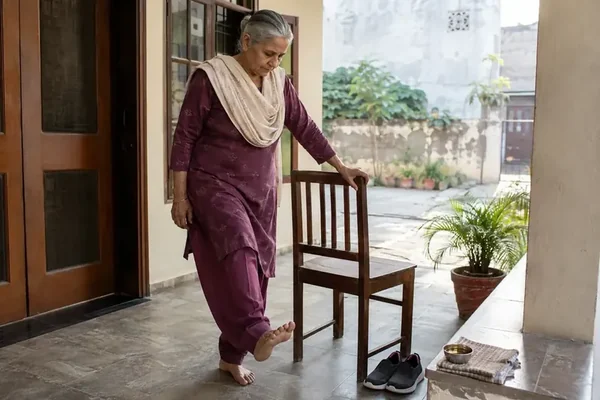
Gridhrasi meaning in Ayurveda. Gṛdhrasī comes from gṛdhra, a vulture. The name recalls the stiff, careful walk of someone whose leg hurts with every step. The closest modern word is sciatica.
Urgent signs: Sciatica in both legs, loss of bladder or bowel control, or numbness around the genitals or buttocks needs emergency care now. A leg or foot that is getting weaker needs a prompt review.4 The full list is under "When it should not wait" on Sciatica (nas ka dard).
| Language | Name |
|---|---|
| Sanskrit | Gṛdhrasī (गृध्रसी): from gṛdhra, a vulture, for the stiff, careful way of walking it can cause |
| Hindi | Nas ka dard, pair mein nas ka khinchav, sciatica |
| Punjabi | Nas da dard, latt vich nas khichni (ਨਸ ਦਾ ਦਰਦ, ਲੱਤ ਵਿੱਚ ਨਸ ਖਿੱਚਣੀ) |
| English | Sciatica: pain, tingling or numbness from the lower back or buttock down the leg |
How Ayurveda describes it
Gṛdhrasī is defined by the path of the pain. It begins in the buttock and travels down the back of the thigh, knee and calf to the foot, with pricking pain and difficulty lifting the leg.1 The classical texts describe two forms. One comes from vāta alone. The other is vāta with kapha, which adds heaviness, drowsiness and poor appetite.1
The causes named are the ones for back pain in general: overexertion, heavy lifting and long journeys (see katiśūla, set beside lower back pain). Care starts by avoiding them, then calming vāta with routine, warmth and suitable food and, where a doctor advises, medicines and procedures.1
How modern medicine describes it
Sciatica is pain from an irritated or pressed nerve root in the lower spine. It is felt along the sciatic nerve, from the buttock down the leg, sometimes with numbness, tingling or weakness.2 The most common cause is a bulging or slipped disc. Narrowing of the spinal canal and a slipped vertebra are others.2
It is diagnosed from the history and an examination. Most people improve within a few weeks. Scans are kept for warning signs, or for when surgery or an injection is being considered.23
Where they agree, and where they differ
| Ayurveda (gṛdhrasī) | Modern medicine (sciatica) | |
|---|---|---|
| The core experience | Pain from the buttock down the back of the leg to the foot | Pain along the sciatic nerve, often with tingling |
| The path of pain | Described in detail, buttock to foot | The same path, from the nerve root to the foot |
| Types | Vāta alone, or vāta with kapha | Grouped by cause: disc, narrowing, slipped vertebra |
| The mechanism | Aggravated vāta in the leg's channels | A pressed or irritated nerve root |
| Tests | Not part of the classical description | Usually none; a scan for warning signs or before procedures |
| Treatment | Avoid causes, calm vāta; medicines and procedures after assessment | Staying active, exercise, pain relief; injection or surgery for some |
This is the pair that agrees most closely. Both describe the same route of pain, both put overexertion and lifting among the triggers, and both place the start of leg pain in the back.
What the evidence does and doesn't show
- Shown: staying active and following an exercise programme help many people with sciatica, and most improve without surgery.23
- Not shown: that bed rest helps. Long rest can slow recovery.2
- Limited: no well-designed trial of Ayurvedic treatment for gṛdhrasī is cited here, and Ayurvedic research as a whole is limited. 5
- Not a substitute: the word gṛdhrasī does not replace emergency care for the warning signs below, or a review when the leg or foot is getting weaker.4
The two types in the texts, vāta alone and vāta with kapha, do not map onto the modern causes of a disc, narrowing or a slipped vertebra. A scan can show which of those is present; the classical type cannot.
What this means for you
Where the pain travels is the most useful detail you can give. Note how far down the leg it reaches, whether it comes on with coughing, sitting or walking, and whether the foot feels weaker or numb.
Get emergency care now for sciatica in both legs, loss of bladder or bowel control, or numbness around the genitals or buttocks.4
Read next
- Sciatica (nas ka dard): pain from the back or buttock down the leg, what helps and when to be seen
- Low back pain: why it happens, red flags and what to do: how ordinary strain differs from a red flag
- bones and joints
A consultation with Dr. D.K. Sharma (BAMS) is ₹500, in person in Ludhiana or by video. The back and legs are examined in person: how you walk, and the strength and feeling in each leg. A personalised Dinacharya (daily-routine) guide follows.
Sources
- Caraka Saṃhitā, Cikitsāsthāna, chapter on vātavyādhi, and Suśruta Saṃhitā, Nidānasthāna, chapter on vātavyādhi (classical sources).
- NHS. Sciatica. nhs.uk.
- NICE. Low back pain and sciatica in over 16s: assessment and management (NG59).
- NHS. Cauda equina syndrome. nhs.uk.
- NCCIH (US National Institutes of Health). Ayurvedic Medicine: In Depth. Last updated January 2019. nccih.nih.gov.
Medical content approved by Dr. D.K. Sharma.
Reviewed by Dr. D.K. Sharma. Approval recorded on 8 November 2026 for this exact text.