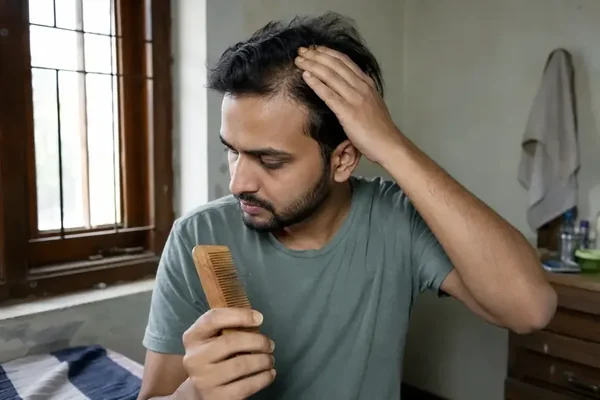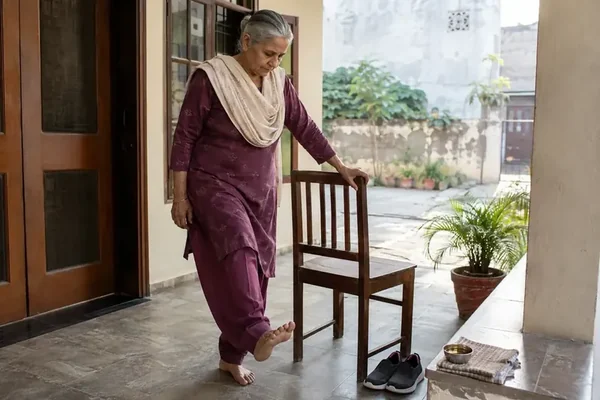

The names
Katishool meaning in Ayurveda. Katiśūla means pain in the kaṭi, the lower back and waist. It is the classical name for what people call kamar dard, and a stiff lower back has its own word, kaṭigraha.
Urgent signs: Back pain with loss of bladder or bowel control, numbness around the genitals or buttocks, or weakness in both legs needs emergency care now.4 The full list is under "When it should not wait" on Lower back pain (kamar dard).
| Language | Name |
|---|---|
| Sanskrit | Katiśūla (कटिशूल): kaṭi, the lower back and waist, and śūla, pain; a stiff lower back is kaṭigraha |
| Hindi | Kamar dard, kamar mein akdan |
| Punjabi | Lakk da dard, kamar dard (ਲੱਕ ਦਾ ਦਰਦ, ਕਮਰ ਦਰਦ) |
| English | Lower back pain; when no single cause is found, non-specific low back pain |
Unlike most terms in this library, katiśūla names a place and a feeling, not a mechanism. Modern medicine does the same when it says "lower back pain".
How Ayurveda describes it
The classical texts describe pain and stiffness of the lower back among the disorders of vāta, the dosha linked with movement. The pain comes on bending, stiffness follows rest, and the ache may spread to the hips.1 They link vāta disorders with heavy lifting, long journeys, overexertion, suppressed natural urges, poor sleep, and dry or irregular food.1
Care starts by removing those causes. Then vāta is calmed with routine, warmth, oiling from outside the body and suitable food and, where a doctor advises, medicines.1 Pain that starts in the back and runs down the leg is a separate disorder, gṛdhrasī. It has its own entry: gṛdhrasī, set beside sciatica.
How modern medicine describes it
Most lower back pain has no single serious cause. Doctors call it non-specific: it comes from the muscles, ligaments, joints and discs of the back working together.23 It often improves within a few weeks, though it can return.2
The assessment is mainly a careful history and examination. Its job is to look for the less common causes that need urgent care or tests. These include pressure on the nerves at the base of the spine, a fracture and an infection.34 Scans are not needed for most people.3
Where they agree, and where they differ
| Ayurveda (katiśūla) | Modern medicine (lower back pain) | |
|---|---|---|
| The core experience | Pain and stiffness of the lower back | Pain and stiffness, sometimes into the buttock |
| Habit and load | Central: lifting, travel, overexertion, urges, sleep | Important: lifting, long sitting, fitness, stress and sleep2 |
| Pain down the leg | A separate disorder, gṛdhrasī | Sciatica, from an irritated nerve root |
| The mechanism | Aggravated vāta in the lower back | Usually non-specific; rarely a serious cause |
| Tests | Not part of the classical description | Usually none; tests for warning signs |
| Treatment | Avoid causes, calm vāta, warmth and oiling; medicines after assessment | Staying active, exercise, manual therapy with exercise, psychological support for some |
The two views meet on habit and load, and both see back pain as more than one sore spot.
What the evidence does and doesn't show
- Shown: staying as active as possible and following an exercise programme help most people with lower back pain.3
- Not shown: that a scan is useful for most back pain. It often shows changes that do not explain the pain.3
- Limited: the research on Ayurvedic treatment is thin overall, and none of it cited here shows that it eases katiśūla. 5
- Not a substitute: calling the pain katiśūla does not rule out the warning signs below, which need emergency care.4
The classical description has no step for ruling out a fracture, an infection or pressure on the nerves. A modern assessment has one.3
What this means for you
The questions that sort out back pain are plain ones. When did it start, and what were you doing? What makes it worse: sitting, lifting, a poor night's sleep? Does it travel into a leg? Any of these answers is worth writing down before a visit.
Get emergency care now for back pain with loss of bladder or bowel control, numbness around the genitals or buttocks, or weakness in both legs.4
Read next
- Lower back pain (kamar dard): the condition, what helps and when to be seen
- Low back pain: why it happens, red flags and what to do: everyday causes, home care and red flags
- bones and joints
A consultation with Dr. D.K. Sharma (BAMS) is ₹500, in person in Ludhiana or by video. The back is examined in person: how you bend and stand, and the nerves in your legs. A personalised Dinacharya (daily-routine) guide follows.
Sources
- Caraka Saṃhitā, Cikitsāsthāna, chapter on vātavyādhi, and Mādhava Nidāna, chapter on vātavyādhi (classical sources).
- NHS. Back pain. nhs.uk.
- NICE. Low back pain and sciatica in over 16s: assessment and management (NG59).
- NHS. Cauda equina syndrome. nhs.uk.
- NCCIH (US National Institutes of Health). Ayurvedic Medicine: In Depth. Last updated January 2019. nccih.nih.gov.
Medical content approved by Dr. D.K. Sharma.
Reviewed by Dr. D.K. Sharma. Approval recorded on 8 November 2026 for this exact text.