
The names
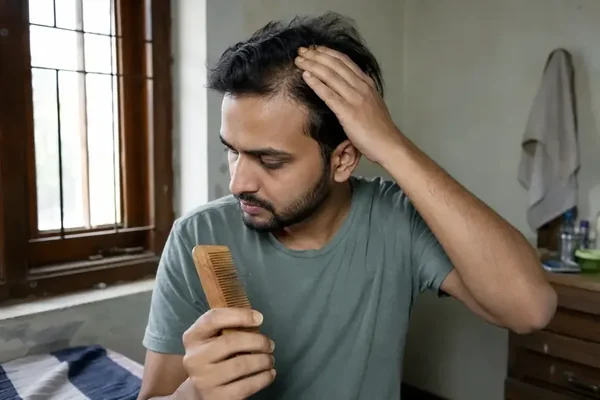
Darunaka meaning in Ayurveda. Dāruṇaka comes from dāruṇa, hard or harsh, for a rough, cracking, itchy scalp. The closest everyday word is dandruff, or rusi.
Urgent signs: Swelling of the face, eyes, lips or tongue, or trouble breathing, after a hair dye or a new product needs emergency help. A painful, hot or swollen scalp with pus-filled sores, or a scaly, sore patch of hair loss, should be assessed soon. The full list is under "When it should not wait" on Dandruff and an itchy scalp.
| Language | Name |
|---|---|
| Sanskrit | Dāruṇaka (दारुणक): from dāruṇa, hard or harsh, for a rough, cracking scalp |
| Hindi | Rusi, sir mein khujli |
| Punjabi | Sikri, sir vich khaarish (ਸਿੱਕਰੀ, ਸਿਰ ਵਿੱਚ ਖਾਰਸ਼) |
| English | Dandruff; when red, greasy and inflamed, seborrhoeic dermatitis |
How Ayurveda describes it
In Ayurveda, dāruṇaka is one of the minor diseases (kṣudraroga) of the scalp: the skin of the head becomes hard, rough and itchy, with flaking and sometimes cracking.1 The classical texts link it with kapha and vāta.1
Contributors named include dryness, cold, an unsuitable diet, poor digestion, late nights and neglect of scalp care. Treatment in the Ayurvedic view starts with avoiding the causes, then care of the scalp, digestion and routine and, where a doctor advises, medicines.
How modern medicine describes it
Modern medicine describes dandruff as white or grey flakes of skin on the scalp, often with itching. It is common, not infectious, and not caused by poor hygiene.2 It is linked with a yeast that lives on everyone's skin and with the scalp's oil; it tends to come and go, and is often worse in winter and at stressful times.23
When the scalp is red, greasy and inflamed, and the eyebrows, sides of the nose or ears are involved, it is called seborrhoeic dermatitis.3 Thick, silvery, well-defined plaques can be psoriasis, and itching after a hair dye can be an allergy; each is assessed differently.45
Where they agree, and where they differ
| Ayurveda (dāruṇaka) | Modern medicine (dandruff, seborrhoeic dermatitis) | |
|---|---|---|
| The core experience | Hard, rough, itchy scalp with flaking | Flakes and itching; redness when inflamed |
| The mechanism | Kapha and vāta | Yeast on the skin, scalp oil, the skin's response |
| Season and stress | Dryness and cold named as factors | Often worse in winter and with stress2 |
| Other conditions | Described as one disorder | Psoriasis, eczema and dye allergy considered |
| Tests | Not part of the classical description | Usually none; examination if it doesn't settle |
| Treatment | Avoid causes, scalp and whole-body care; medicines after assessment | Regular medicated shampoos; prescribed treatment if needed |
Both views agree that a flaking scalp tends to return, that season, stress and routine play a part, and that steady scalp care matters more than frequent product changes.
What the evidence does and doesn't show
- Shown: regular washing with a suitable medicated shampoo controls dandruff for most people, though it tends to come back if stopped.2
- Not shown: that dandruff comes from being unclean, or that it spreads from person to person.2
- Limited: clinical trials of Ayurvedic treatments have mostly been few, small or not well designed, so firm conclusions about dāruṇaka cannot be drawn. 6
- Not a substitute: an Ayurvedic label doesn't replace an assessment when the scalp is sore, weeping, very red or losing hair in patches.3
What this means for you
A flaking scalp is easier to sort out when you can say what makes it better or worse. Note the season, stress, sleep, the products and oils you use, how often you wash, and whether other areas of skin are involved. Bring the shampoos you have already tried.
Read next
- Dandruff and an itchy scalp: what helps and when to be seen
- khalitya: if hair is also falling
- skin and hair
A consultation with Dr. D.K. Sharma (BAMS) is ₹500, in person in Ludhiana or by video. Dr. Sharma asks what makes the scalp better or worse, what you use on it and about your health, and, in person, looks at the scalp. This helps tell ordinary dandruff from a scalp problem that needs a different assessment. A personalised Dinacharya (daily-routine) guide follows.
Sources
- Suśruta Saṃhitā, Nidānasthāna, chapter on kṣudraroga, and Mādhava Nidāna, chapter on kṣudraroga (classical sources).
- NHS. Dandruff. nhs.uk.
- NHS. Seborrhoeic dermatitis. nhs.uk.
- NHS. Psoriasis. nhs.uk.
- NHS. Hair dye reactions. nhs.uk.
- NCCIH (US National Institutes of Health). Ayurvedic Medicine: In Depth. Last updated January 2019. nccih.nih.gov.
Medical content approved by Dr. D.K. Sharma.
Reviewed by Dr. D.K. Sharma. Approval recorded on 8 November 2026 for this exact text.