
The names
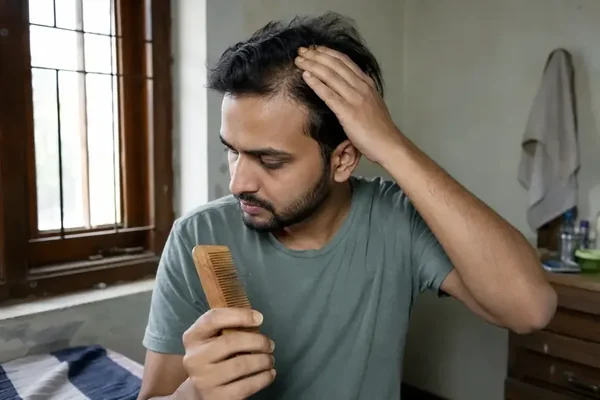
Khalitya meaning in Ayurveda. Khālitya means a gradual loss of hair from the scalp: hair fall, or baal jhadna.
When to see a doctor: Hair fall is rarely an emergency. Clear round patches, a painful, red or scaly scalp with sores, hair coming out quickly all over, or hair fall with tiredness, weight change or irregular periods should be assessed soon.23 The full list is under "When it should not wait" on Hair fall (baal jhadna).
| Language | Name |
|---|---|
| Sanskrit | Khālitya (खालित्य): gradual loss of hair from the scalp |
| Hindi | Baal jhadna, baal girna |
| Punjabi | Vaal jharne, vaal kirne (ਵਾਲ ਝੜਨੇ, ਵਾਲ ਕਿਰਨੇ) |
| English | Hair fall, hair loss; in medical terms, alopecia |
How Ayurveda describes it
In Ayurveda, khālitya is one of the minor diseases (kṣudraroga) of the head.1 The classical texts describe pitta, together with vāta, reaching the hair roots and making the hair fall, and kapha with blood (rakta) then blocking the roots.1 Hair is also linked with the health of the bone tissue (asthi dhātu) and with digestion.
Heat-producing habits, anger and stress, late nights, poor nutrition and an unsuitable diet are named as contributors.1 Treatment in the Ayurvedic view starts with avoiding the causes, then care of the scalp, digestion, sleep and routine and, where a doctor advises, medicines.
How modern medicine describes it
Modern medicine starts by noting that losing some hair every day, often 50 to 100 hairs, is normal.23 Hair loss beyond that has several patterns: inherited thinning at the crown, temples or parting; heavy shedding two or three months after illness, childbirth, surgery or stress; round bald patches (alopecia areata); and hair loss from scalp infection or scarring.23
Diagnosis is from the history and a look at the scalp. Blood tests for iron, thyroid and other causes are used when the picture suggests them.3
Where they agree, and where they differ
| Ayurveda (khālitya) | Modern medicine (hair loss, alopecia) | |
|---|---|---|
| The core experience | Hair falling from the roots, thinning | Shedding, thinning or patches |
| Kinds | Described as one disorder of the hair roots | Several types, each with its own course |
| The mechanism | Pitta and vāta at the roots; kapha and rakta blocking them | Genes and hormones, a shock to the body, immune causes, scalp disease |
| Stress and diet | Named as contributors | Illness, stress and low iron can trigger shedding23 |
| Tests | Not part of the classical description | Iron, thyroid and other blood tests when suggested |
| Treatment | Avoid causes, scalp and whole-body care; medicines after assessment | Depends on the type; treat the cause; prescribed treatments |
Both views agree that hair fall is often a sign of something in the wider body, and that sleep, stress and nutrition are worth looking at.
What the evidence does and doesn't show
- Shown: shedding after illness, childbirth or a stressful event usually settles on its own over some months.2
- Not shown: that hair loss has one cause or one remedy for everyone; the type decides what helps.3
- Limited: clinical trials of Ayurvedic treatments have mostly been few, small or not well designed, so firm conclusions about khālitya cannot be drawn. 4
- Not a substitute: an Ayurvedic label doesn't replace a check of iron and thyroid when needed, or an assessment of sudden patches, a sore or scaly scalp.23
What this means for you
Shedding often follows an illness, childbirth or a hard stretch by two or three months, so start by writing down when it began and what happened before it. Add your diet, sleep, periods and any medicines, and check iron and thyroid if the history points that way. Bring the oils and shampoos you use.
Read next
- Hair fall (baal jhadna): the patterns, what helps and when to be seen
- palitya for early greying and darunaka for a flaking scalp
- skin and hair
A consultation with Dr. D.K. Sharma (BAMS) is ₹500, in person in Ludhiana or by video. Dr. Sharma asks when the shedding began, what happened before it and about your general health, and, in person, looks at your scalp. This helps decide whether iron and thyroid checks are worth doing first. A personalised Dinacharya (daily-routine) guide follows.
Sources
- Suśruta Saṃhitā, Nidānasthāna, chapter on kṣudraroga, and Mādhava Nidāna, chapter on kṣudraroga (classical sources).
- NHS. Hair loss. nhs.uk.
- American Academy of Dermatology. Hair loss: who gets and causes. aad.org.
- NCCIH (US National Institutes of Health). Ayurvedic Medicine: In Depth. Last updated January 2019. nccih.nih.gov.
Medical content approved by Dr. D.K. Sharma.
Reviewed by Dr. D.K. Sharma. Approval recorded on 8 November 2026 for this exact text.