
The names
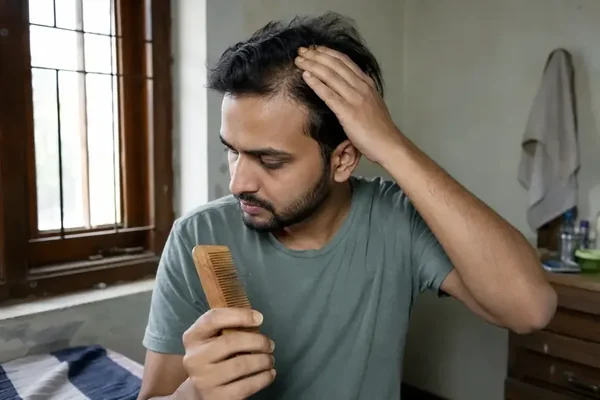
Palitya meaning in Ayurveda. Pālitya means greying of the hair, and akāla pālitya is greying before its time: safed baal at a young age.
Urgent signs: Swelling of the face, eyes, lips or tongue, or trouble breathing, after a hair dye needs emergency help. Greying with tiredness, pins and needles or a sore red tongue, or a white patch of hair over a pale patch of skin, should be assessed soon. The full list is under "When it should not wait" on White hair at a young age.
| Language | Name |
|---|---|
| Sanskrit | Pālitya (पालित्य): greying of the hair; akāla pālitya, greying before its time |
| Hindi | Safed baal, kam umar mein baal safed hona |
| Punjabi | Chitte vaal, chhoti umar vich vaal chitte hone (ਚਿੱਟੇ ਵਾਲ, ਛੋਟੀ ਉਮਰ ਵਿੱਚ ਵਾਲ ਚਿੱਟੇ ਹੋਣੇ) |
| English | Grey or white hair; when early, premature greying |
How Ayurveda describes it
In Ayurveda, pālitya is one of the minor diseases (kṣudraroga) when it comes early.1 The classical texts describe the body's heat (pitta), stirred by anger, grief and exhaustion, reaching the scalp and turning the hair white.1 Greying with age is seen as natural; akāla pālitya, greying before its time, is the concern.
Contributors named include stress, late nights, heat-producing food and habits, and poor nutrition. Care in the Ayurvedic view starts with avoiding the causes, then digestion, sleep, routine and rasāyana, the tradition of supporting strength, and, where a doctor advises, medicines.
How modern medicine describes it
Modern medicine explains grey hair as the hair follicles making less pigment over time. Greying with age is normal, and the age it starts is decided mostly by genes: the age your parents greyed is the strongest guide.2
Early greying has been linked with low vitamin B12.3 Thyroid problems and smoking have also been reported alongside it in some studies, though the evidence is weaker.
A patch of white hair over a pale patch of skin can be vitiligo and is assessed separately.5 Hair dyes can cause allergic reactions, so a patch test before each use is advised.4
Where they agree, and where they differ
| Ayurveda (pālitya) | Modern medicine (premature greying) | |
|---|---|---|
| The starting point | Greying with age is natural; early greying is a disorder | Greying with age is normal; early greying is mostly inherited |
| The mechanism | Pitta, heat reaching the scalp | Less pigment made by the hair follicles |
| Family pattern | Not central in the classical description | The main factor2 |
| Stress and habits | Anger, grief and exhaustion named | Smoking reported with earlier greying in some studies |
| Tests | Not part of the classical description | B12 and thyroid checks when suggested3 |
| Treatment | Avoid causes, rasāyana, routine; medicines after assessment | Treat any cause found; hair dye is a choice, with a patch test |
Both views agree that greying with age is natural, that early greying can carry a message about general health, and that sleep, stress and nutrition are worth looking at.
What the evidence does and doesn't show
- Shown: genes are the strongest factor in when greying starts.2
- Not shown: that inherited greying can be turned back by any product or diet.2
- Limited: clinical trials of Ayurvedic treatments have mostly been few, small or not well designed, so firm conclusions about pālitya cannot be drawn. 6
- Not a substitute: an Ayurvedic label doesn't replace a check for low B12 or thyroid problems, or an assessment of white patches of skin.35
What this means for you
When greying starts early, note your family pattern first, then your diet (especially if you eat little or no animal food), thyroid symptoms, smoking, sleep and stress. Also note whether any patch of skin has turned pale.
Read next
- White hair at a young age: what is checked and what helps
- khalitya if hair is also thinning, or shvitra if a skin patch is pale
- skin and hair
A consultation with Dr. D.K. Sharma (BAMS) is ₹500, in person in Ludhiana or by video. Dr. Sharma asks about your family pattern, diet and health, and, in person, looks at the hair and scalp. This helps decide whether a B12 or thyroid check is worth doing. A personalised Dinacharya (daily-routine) guide follows.
Sources
- Suśruta Saṃhitā, Nidānasthāna, chapter on kṣudraroga, and Mādhava Nidāna, chapter on kṣudraroga (classical sources).
- MedlinePlus. Aging changes in hair and nails. medlineplus.gov.
- NHS. Vitamin B12 or folate deficiency anaemia. nhs.uk.
- NHS. Hair dye reactions. nhs.uk.
- NHS. Vitiligo. nhs.uk.
- NCCIH (US National Institutes of Health). Ayurvedic Medicine: In Depth. Last updated January 2019. nccih.nih.gov.
Medical content approved by Dr. D.K. Sharma.
Reviewed by Dr. D.K. Sharma. Approval recorded on 8 November 2026 for this exact text.